
Natural Meadow Restoration Initiative at the Arboretum of VMU Agriculture Academy: Living Lab Contribution to Nature-Based Solutions
On June 27, 2025, a natural meadow restoration initiative was implemented at the Arboretum of Vytautas Magnus University Agriculture Academy. The aim of this initiative was to promote biodiversity and integrate nature-based solutions (NBS) into education and environmental practice.
As part of the activity, Arboretum staff prepared an experimental plot for natural meadow establishment: the existing vegetation was mowed, biomass removed, and soil scarification carried out to create suitable conditions for new plant establishment. A meadow restoration expert developed a native seed mix tailored to local conditions, distinguished by high species diversity and ecological value. The seeds were sown in designated plots within the Arboretum territory.
The activity involved the VMU Agriculture Academy Living Lab team and students from the Faculty of Forest Sciences and Ecology. It provided a unique opportunity for students to gain hands-on experience in natural meadow restoration, learn about the role of native plant species in ecosystem stability, and explore the application of nature-based solutions in modern agriculture.
The restored meadows will serve as a demonstration site for the Living Lab, used in study programs, educational activities, community cooperation, and international exchanges. These natural spaces will contribute to the development of environmental competences and the integration of NBS principles into higher education.
This initiative was implemented within the framework of the international project “Education and Nature-Based Solutions: enable society to bend the curve for biodiversity” (ENABLS). The project aims to strengthen the role of education in biodiversity conservation through local initiatives, experiential learning, and collaboration between science and society.
Moments from the VMU Agriculture Academy Graduation Ceremony (photo gallery)
On June 19, a special chapter was written in the life book of graduates from Vytautas Magnus University Agriculture Academy – on this day, diplomas were awarded to the young creators of a sustainable future, conferring Bachelor’s and Master’s degrees.
Access to the photo galleries is granted only to users with a VMU email address.
The Second Erasmus+ “Bumble-NAP” Project Meeting in Italy
On June 26–27, 2025, the second international meeting of the Erasmus+ project “Bumblebees for Natural Pollination” (BUMBLE-NAP, No. 2024-1-TR01-KA220-VET-000254015) was held in Perugia, Italy. The meeting brought together representatives from Turkey, Italy, Bulgaria, and Lithuania. Vytautas Magnus University was represented by the team from the Department of Environmental Sciences and Ecology at the Agriculture Academy.
As part of the project’s activities, the aim is to promote the use of bumblebees in greenhouse farming as a natural alternative for pollination, reducing the use of chemical substances and hormones in agriculture. The project is coordinated by the Municipality of Serik in Antalya (Turkey), with partners including Aydin Adnan Menderes University (Turkey), the Farmers’ Confederation of the Umbria Region (Italy), the Institute of Agriculture of Stara Zagora (Bulgaria), and Vytautas Magnus University (Department of Environmental Sciences and Ecology, Agriculture Academy, Lithuania). The project runs for two years, with completion scheduled for November 30, 2026.
The main objective of the project is not only to support environmentally friendly pollinators like bumblebees in greenhouse agriculture but also to strengthen the vocational education and training (VET) system in the agricultural sector by developing practical learning tools and methodological materials.
On the first day of the meeting, held at the CIA Umbria office in Perugia, partners presented project coordination and management progress and discussed national research results from Turkey, Bulgaria, Italy, and Lithuania. The VMU Agriculture Academy team shared the outcomes of the Lithuanian study, highlighting both strengths and areas for improvement in the practical use of bumblebees in agriculture.
Additionally, the development of an e-learning platform and the structure of upcoming interactive training modules were presented. Partners discussed future dissemination tools, including educational videos, a methodological handbook, and a practical training course aimed at greenhouse workers and VET institutions. The meeting concluded with a discussion on financial and management issues, as well as planning for the third partner meeting.
The second day was dedicated to an educational visit to the Augusto Ciuffelli Agricultural College – the oldest agricultural education institution in Italy, operating since 1864. The college is located in Todi, within the historic 12th-century Montecristo Monastery complex, and is recognized for its strong infrastructure for practical training.
Partners visited modern hydroponic cultivation systems – highly relevant to the topic of greenhouse pollination – and explored the college’s educational farm, which includes olive groves, vineyards, and precision agriculture experiments.
A highlight of the visit was the ceroplastic collection of wax fruit models, reflecting ancient fruit varieties. These meticulously crafted models are used for educational purposes and help foster understanding of regional plant diversity and its conservation.
Participation in this meeting strengthened international collaboration, encouraged the exchange of knowledge on bumblebees as a sustainable pollination method, and supported further development of the project’s educational tools. The contribution of the VMU Agriculture Academy team to research analysis and learning content development is a vital part of the project’s overall progress.
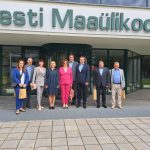
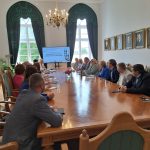
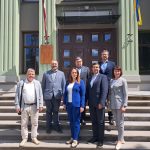
Strengthening the Partnership between VMU Agriculture Academy, Estonian University of Life Sciences, and Latvia University of Life Sciences and Technologies – Shared Visions for the Future
A delegation of leaders from the Vytautas Magnus University (VMU) Agriculture Academy, led by Chancellor Prof. Dr. Astrida Miceikienė, along with Vice-Chancellor Prof. Dr. Aušra Blinstrubienė, Head of the Administrative Group Dr. Laima Skauronė, Dean of the Faculty of Agronomy Assoc. Prof. Dr. Aida Adamavičienė, Dean of the Faculty of Bioeconomy Development Prof. Dr. Bernardas Vaznonis, Dean of the Faculty of Engineering Assoc. Prof. Dr. Rolandas Domeika, and Dean of the Faculty of Forest Sciences and Ecology Prof. Dr. Vitas Marozas, visited two strategic partner universities in June – the Estonian University of Life Sciences (EMÜ) in Tartu and the Latvia University of Life Sciences and Technologies (LBTU) in Jelgava.
The aim of this visit was to strengthen the partnership between the three Baltic life sciences institutions by discussing the expansion of joint projects, enhancing the international dimension of studies, developing academic and student exchange programs, and participating in international academic initiatives. Throughout the visit, intensive discussions were held on double degree opportunities, collaborative research initiatives, and inter-institutional cooperation.
At the Estonian University of Life Sciences, particular attention was given to science policy and strengthening project-based activities. The open, professional, and warm communication with EMÜ representatives not only encouraged new ideas but also reaffirmed the importance of shared values in shaping long-term collaboration. Meanwhile, the Latvia University of Life Sciences and Technologies left a strong impression with its state-of-the-art research infrastructure – ranging from plant protection and forestry to alternative fuels and interdisciplinary science laboratories. During the visit, significant personal contacts were established with LBTU researchers and administrators, and further cooperation within the BOVA network, blended intensive programs (BIP), and academic conferences was discussed.
The VMU Agriculture Academy sincerely thanks Rector Ülle Jaakma of EMÜ and Rector Irina Arhipova of LBTU and their teams for their warm hospitality, professional dialogue, and genuine openness to collaboration. This visit further strengthened the commitment of all three institutions to shaping a sustainable and innovative future in the field of life sciences across the Baltic region.
During the visit, the delegation also had the opportunity to explore the historic Old Town of Tallinn, while free time in Tartu and Jelgava offered a chance to experience the unique cultural and historical atmosphere of both cities.
The VMU Agriculture Academy is pleased with this new stage of strengthened cooperation and eagerly awaits the arrival of its international colleagues in Lithuania for the international conference “Rural Development 2025,” which will take place on October 1–3 at the VMU Agriculture Academy. More information about the conference is available at https://ruraldevelopment.lt
For more information about our partner universities:
Estonian University of Life Sciences – https://www.emu.ee/en
Latvia University of Life Sciences and Technologies – https://www.lbtu.lv
International Workshop: measurement of N2O/H2O and CH4/CO2/H2O gases in soil
International Workshop: measurement of N2O/H2O and CH4/CO2/H2O gases in soil
The Bioeconomy Research Centre of Excellence of the Bioeconomy Research Institute (BTI) of the Vytautas Magnus University, Agriculture Academy, invites lecturers, researchers, PhD students and graduate and post-doctoral students and other interested to take part in a international workshop on the Measurement of N2O/H2O and CH4/CO2/H2O in Soil.
During the workshop, a product application specialist from LI-COR Environmental — the manufacturer of the instruments — based at LI-COR’s German office, will share their expertise on measuring soil gases under natural field conditions.
In addition to theoretical insights, participants will have the opportunity to practice measurements in the field and learn essential information on measurement accuracy, data interpretation, and practical applications.
Date: 3 July 2025, 09:00-16:00 (Theoretical and practical parts)
Venue: Experimental Station of VMU Agriculture Academy (Rapsų g. 7, Noreikiškės, Kaunas district)
Duration: 6 hours.
Organisers: BioTEC, Vildoma, LI-COR, VMU Agriculture Academy, Agronomy Faculty, Agroecosystems and Soil Sciences Department, Bioeconomy Research Institute, Experimental Station.
This workshop is one of the activities of the project ‘Development of the Bioeconomy Research Centre of Excellence (BioTEC)’. The project is funded by the Ministry of Education, Science and Sports of the Republic of Lithuania, and the Research Council of Lithuania Contract No S-A-UEI-23-14. The funding programme is the ‘Universities` Excellence Initiative’ (No V-940).
Master’s Studies in English – Made in Lithuania
Have you completed your Bachelor’s degree in Lithuania? Take the next step with a Master’s programme in English at Vytautas Magnus University Agriculture Academy.
Available programmes:
Study in Kaunas at a high-ranking university and gain a future-oriented qualification in a globally relevant field.
Start: Autumn 2025.
Apply now: https://vytautasmagnus.dreamapply.com.
Graduation ceremony
On 19 June, Vytautas Magnus University Agriculture Academy invites graduates to participate in festive graduation events.
FESTIVE HALL OF VMU AGRICULTURE ACADEMY | STUDENTŲ G. 11, AKADEMIJA, KAUNAS DISTRICT
10:00 a.m. Graduation ceremony of the Faculty of Bioeconomy Development of VMU Agriculture Academy
12:00 p.m. Graduation ceremony of the Faculty of Agronomy of VMU Agriculture Academy
2:00 p.m. Graduation ceremony of the Faculty of Forest Sciences and Ecology of VMU Agriculture Academy
4:00 p.m. Graduation ceremony of the Faculty of Engineering of VMU Agriculture Academy
We would like to inform you that the event may be filmed and/or photographed, and you may appear in event photos or videos that could be published across various media platforms.
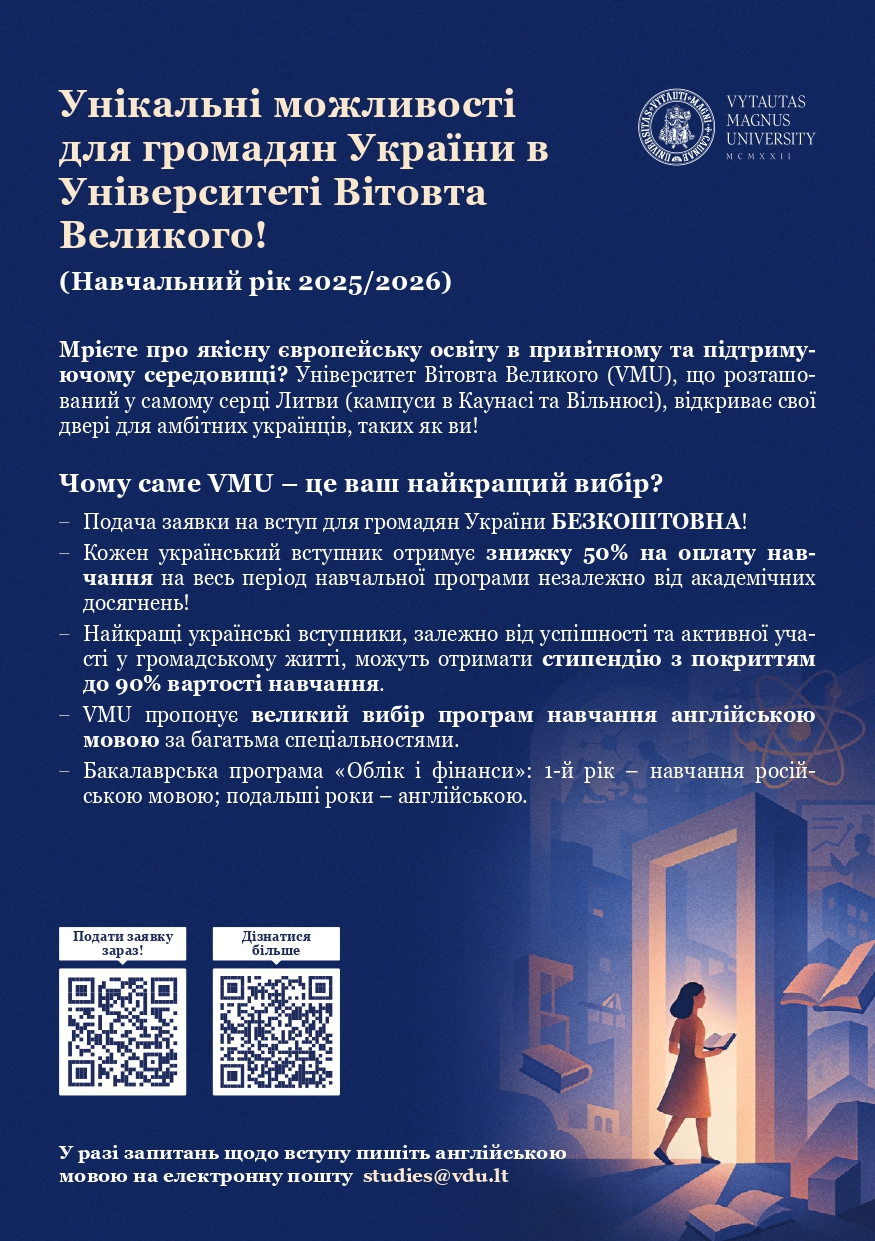
Exceptional Opportunities for Ukrainian Citizens at VMU Agriculture Academy
Academic Year 2025/2026 | Vytautas Magnus University, Lithuania
Vytautas Magnus University (VMU) Agriculture Academy, located in the vibrant city of Kaunas, Lithuania, invites ambitious Ukrainian citizens to join its diverse academic community. Offering high-quality European education in a supportive and inclusive environment, VMU is proud to stand with Ukraine by providing accessible education opportunities during challenging times.
Why Choose VMU Agriculture Academy?
- No Application Fee. All Ukrainian applicants are exempt from the application fee.
- 50% Tuition Fee Waiver. Every Ukrainian student automatically receives a 50% discount on tuition for the entire duration of their studies, regardless of academic performance.
- Scholarships up to 90%. Top-performing students with outstanding academic achievements and active civic engagement may receive scholarships covering up to 90% of tuition costs.
- English-Taught Programmes. VMU offers a wide range of undergraduate programmes in English, designed to equip students with internationally competitive skills and knowledge.
Featured Study Programmes:
- Accounting and Finance. Start your journey with the first year taught in Russian and continue the remaining years in English. Learn more & apply.
- Sustainable Engineering. A forward-thinking programme aimed at those passionate about environmental responsibility and innovation. Learn more & apply.
Apply Today
Take the first step toward a brighter academic future at VMU Agriculture Academy. Join a university that values excellence, community, and your potential.
For questions or assistance with the application process, please contact VMU admissions team at studies@vdu.lt.
ERASMUS BIP at the Faculty of Bioeconomic Development of the VMU Agriculture Academy: exploring AI in economic modelling
From May 12 to 16, 2025, the Faculty of Bioeconomy Development at Vytautas Magnus University Agriculture Academy (VMU AA) welcomed an inspiring cohort of doctoral and master’s students from across Europe to participate in the Erasmus Blended Intensive Programme (BIP) titled “AI in Economic Modelling.” This international event combined virtual and on-site learning, with the preparatory session held online on May 5 and the in-person programme taking place in Kaunas, Lithuania.
The participant group reflected the programme’s truly European character: doctoral students arrived from Finland, Latvia, Estonia, Romania, Croatia, and Lithuania, while a group of highly motivated master’s students represented Poland. Their diverse backgrounds and shared interest in advanced AI applications in economics created a vibrant and collaborative academic environment.
AI Tools for the Economists of Tomorrow
The core of the programme focused on the integration of artificial intelligence in the construction and simulation of economic models. Students were introduced to state-of-the-art methods such as neural networks, fuzzy systems, probabilistic reasoning, and evolutionary computing. Topics in explainable AI were emphasized, along with comparative insights on traditional mathematical and statistical modelling.
The lectures were delivered by an esteemed lineup of professors, including Prof. Dr. Vesa Niskanen (VMU & University of Helsinki), Prof. Laszlo T. Koczy (Budapest University of Technology and Economics), Academician Janusz Kacprzyk (Polish Academy of Sciences), Prof. Chister Carlsson (IAMSR, Finland), and Prof. Dr. Irina Archipova (Latvia University of Life Sciences and Technologies). Their sessions spanned topics from decision support systems and fuzzy analytics to the differences between machine learning and statistical models.
Cultural Enrichment and Networking
Beyond the academic programme, students had the opportunity to explore Lithuanian culture and history through a guided excursion in Kaunas Old Town. Social gatherings, including a welcome dinner at the traditional “Medžiotojų užeiga” restaurant, encouraged participants to network and build lasting academic friendships.
Panel discussions and informal conversations enhanced the sense of collaboration, creating an atmosphere of openness and intellectual curiosity. The week blended structured learning with spontaneous exchange, fostering a strong sense of international academic community.
A Platform for Future Collaboration
This course was also part of the collaborative activities within the BOVA-NOVA university network, initiated and supported by the BOVA university network. It reflected the ongoing efforts to strengthen regional cooperation in higher education and research across the Baltic and Nordic countries.
Organized by Dr. Monika Medikienė (VMU Agriculture Academy International Coordinator) and Dr. Ekaterina Makrickienė (VMU Agriculture Academy BOVA Coordinator), with academic leadership from Prof. Dr. Vesa Niskanen (VMU Faculty of Bioeconomy Development and University of Helsinki), the programme granted participants 3 ECTS credits and was financed by the Erasmus+ funds and internal funds of BOVA university network.
The BIP “AI in Economic Modelling” not only empowered students with cutting-edge AI knowledge but also encouraged intercultural dialogue and laid the foundation for future interdisciplinary research collaborations. As AI continues to contribute to the economic landscape, programmes like this play a critical role in preparing the next generation of economists to lead with insight, innovation, and international perspective.

Co-Funded by the European Union. Views and opinions expressed are however those of the author(s) only and do not necessarily reflect those of the European Union or the European Education and Culture Executive Agency (EACEA). Neither the European Union nor EACEA can be held responsible for them.
ENABLS project partners gathered in Wageningen university to advance sustainable change through co-creation and living labs
On 7–8 May 2025, the third plenary meeting of the ENABLS project (Education and Nature-Based Solutions: enable society to bend the curve for biodiversity) took place at one of Europe’s greenest and most forward-thinking universities – Wageningen University & Research (WUR, the Netherlands). The event brought together project partners from all eleven participating countries, including representatives from universities, research institutes, consultancy organisations, and professional networks.
Wageningen University is globally recognised for its leadership in environmental protection, sustainable agriculture, food systems, and climate change research. It is also a pioneer in the practical implementation of nature-based solutions (NBS) and the living lab methodology, which fosters dialogue between science, policy, and society to co-create meaningful, real-world solutions. From urban gardens to experimental food forests, WUR offers outstanding examples of how sustainability can be implemented in practice.
We are pleased to share that Vytautas Magnus University was represented by experts from the Faculty of Forestry and Ecology, who are actively engaged in integrating nature-based solutions into both education systems and community-driven initiatives.
The two-day meeting featured a dynamic format, combining in-depth discussions with outdoor activities. The first day focused on the development of vocational education (TVET) modules, the integration of NBS into higher education curricula, and methods for assessing the project’s impact. Participants also exchanged experiences related to communication strategies, dissemination of results, and ensuring the long-term sustainability of project outcomes.
The second day was dedicated to hands-on sessions exploring the application of living labs in different contexts. Project partners and coaches shared their approaches to strengthening community involvement, fostering a culture of reflection, and tracking progress. A variety of practical tools were presented, including participant reflection journals, observation templates, and co-creation session records. The day concluded with an inspiring visit to the Wageningen Food Forest, where participants engaged in field-based learning and reflective dialogue.
The plenary meeting reaffirmed the importance of the ENABLS project not only as a platform for sharing theoretical knowledge but as a driver of real, tangible change. Through partnerships between academic institutions and communities, and through collaborative learning in real-life environments, the living lab methodology is helping to develop the skills and mindsets needed to address complex environmental challenges.
- About
- About Agri-Food BM programme
- Academic infrastructure units
- All events
- All news
- Aquaculture center
- Archives
- Biosystems Engineering
- Center of Animal husbandry selections, breeding values and dissemination
- Centre of Biosystems Engineering, Biomass Energetics and Water Engineering
- Circular Biobased Economy
- Climate change
- Contacts
- Contacts
- Events
- Events archive
- Faculties
- For business and society
- Innovative products
- International Cooperation
- International projects
- Joint Research Centre of Agriculture and Forestry
- Journal “Human and Nature Safety”
- Laboratory of Technology Safety
- Laboratory services
- Living Environment
- More labs
- News
- Project
- QUALS project description
- Research
- Research areas
- Scientific events
- Scope
- Sitemap
- Studies
- Study programmes
- Technology Transfer & Commercialization
- THE ROLE OF ORGANISATION IN THE PROJECT
- THE ROLE OF ORGANISATION IN THE PROJECT
- THE ROLE OF ORGANISATION IN THE PROJECT
- The Study Process
- Žemės ūkio žinių ir inovacijų sistemos klasteris